


Data-driven insights for fixed income
With the specifics of European regulatory development coming into view, so must the granularity of the data improve to serve fixed income investor mandates and reporting requirements. Marina Petroleka and Gianluca Spinetti tell Environmental Finance how Sustainable Fitch responding
Environmental Finance: How are regulations shaping investor mandates in 2025?
Marina Petroleka, managing director, global head of research: As one of the largest sustainable finance markets, European regulatory developments continue to shape investor behaviour. In 2025, the key focus areas include updates to disclosure requirements via the Corporate Sustainability Reporting Directive (CSRD) Omnibus and the ongoing review of the Sustainable Finance Disclosure Regulation (SFDR). Both are front of mind for investors in 2025 and are central to discussions around EU taxonomy alignment, the scope of disclosures, how those things influence the data that stakeholders have and how investors access decision-useful information.
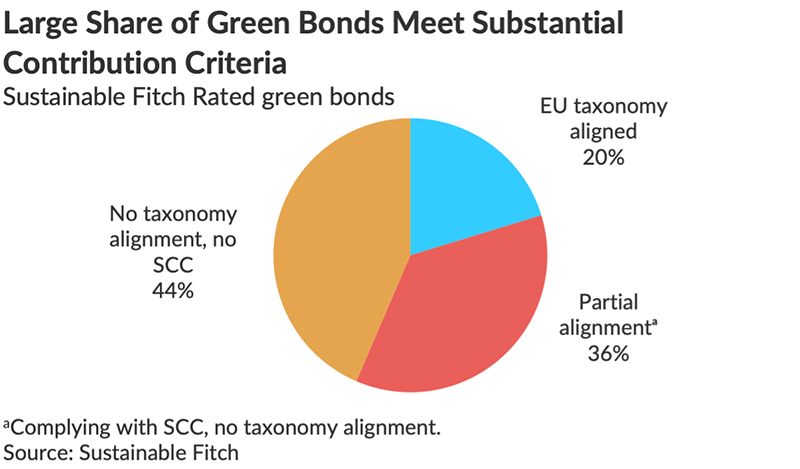
 One notable aspect of the Omnibus proposals is the potential introduction of partial EU taxonomy alignment, on a voluntary reporting basis. Traditionally, alignment has been binary: either an activity is taxonomy-aligned or it’s not. While the definition of partial alignment is still to be clarified, under our understanding it could recognise activities that meet the ‘substantial contribution’ criteria but fail to meet either the ‘do no significant harm’ or the ‘minimum safeguards’ criteria. When we looked at EU taxonomy alignment of green bonds in our rated universe, we found that 20% of green bonds meet EU-taxonomy alignment on a use-of-proceeds basis, while another 36% were deemed to be partially aligned.
This proposal could expand the investable universe by giving investors in the fixed income space more granular insight into activities that are progressing toward alignment. The Omnibus is also proposing looking at some of the hardest to meet do no significant harm (DNSH) elements around pollution, prevention, by making it easier for some corporates who might lack information needed to meet alignment.
Gianluca Spinetti, global head of analytics and product development: Another recent development has been the European Securities and Markets Authority (ESMA) fund naming guidelines, which includes specific criteria around exclusions under the Paris-Aligned Benchmark (PAB) guidelines. For fixed income markets, the challenge lies in the ‘look-through’ exercise – being able to assess underlying holdings for alignment. To solve that, we’ve created a dataset that maps all labelled bonds against the seven PAB exclusion criteria (e.g. tobacco, controversial weapons, fossil fuels, etc) and the climate transition benchmark (CTB) subset criteria as well.
Regulation is a significant driver for our product development, and, in response, we’ve built robust data sets that cover taxonomy alignment, PAB exclusions, and SFDR Principal Adverse Impact (PAI) indicators so that fixed income investors can access entity-by-entity and bond-by-bond level insights on their holdings.
EF: Let’s move to broader market shifts. How else are investor data needs evolving?
MP: There’s a clear trend toward more specific and granular data in fixed income. Investors want visibility across the lifecycle of a bond: from the framework analysis to reporting on impact and SDG-alignment. This demand is driven by increasing sophistication in the labelled bond market, the proliferation of bonds, and requests from investors to demonstrate credible sustainability impacts as it relates to the money allocated.
To support this, we maintain an extensive impact metrics dataset. About 12 months after a bond is launched, we will be able to collect that information, standardise it and create some layer of classification around key categories.
These metrics are standardised and categorised into about 30 key themes – such as emissions avoided or socioeconomic impacts – which align with investor reporting needs.
We’ve just launched SDG-alignment assessments at the use-of-proceeds level. This is a direct response to growing demand, especially from asset owners and LPs who require evidence of real-world outcomes.
We’ve also expanded our data coverage of private markets and other environmental or social indicators that may be harder to come by. For instance, we provide SFDR PAI indicators and scoring at the entity level, even in the small and medium-sized enterprises (SMEs) space.
EF: How do you handle data coverage in the private markets, where disclosure is often limited?
 MP: One of our USPs is we apply an analytical overlay through our in-house experts. While much of our data collection is systematic, we place a strong emphasis on expertise fused with our assessments of the data. Our team speak to investors regularly to ensure quality control, consistency, and contextual insight. This human interaction with the datasets allows us to interpret trends, guide clients, and connect the data with market trends and issues that could be relevant to investors.
GS: We include a human factor – for the analytical overlay – as we feel this makes us distinct from more technology-driven competitors. Furthermore, we pride ourselves on having the content but also the flexibility for our clients to digest that data however they need it. We offer data delivery through various channels: API feeds, Excel, and a newly launched website. We also partner with aggregators to ensure our clients can access content however they require it.
EF: As sustainable finance is becoming more data-intensive, what’s next for Sustainable Fitch and its offerings?
GS: We have previously focused a lot of our attention on issuer activities, but we will be focusing more on the investor side of things and producing separate datasets on climate targets, physical risk and transition risk. We will also be investing in our technology to enhance our analytical capabilities.
For more information, see: www.sustainablefitch.com
